
How to Care for Micro Ferns in Terrariums
How to keep micro ferns healthy in a terrarium: what to grow them on, and the light, temperature, watering and airflow they need.
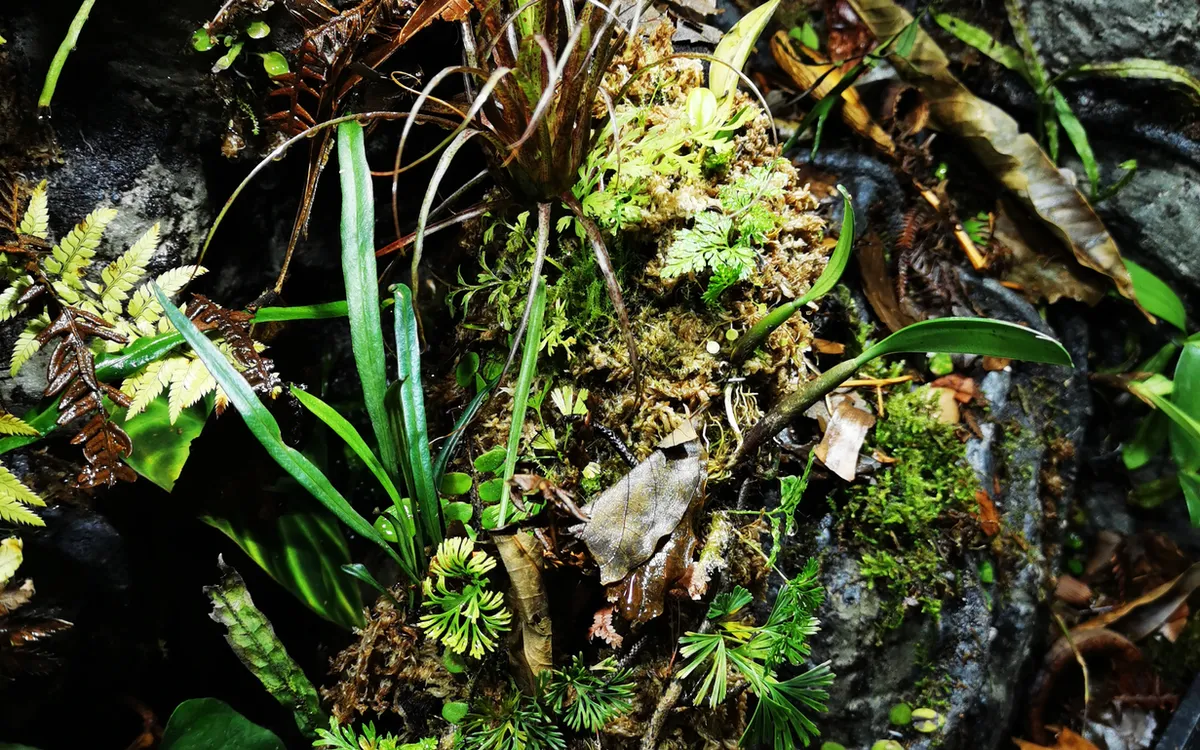
Micro ferns are popular terrarium plants because they stay small, look delicate and adapt well. They aren’t hard to keep, but they do have specific needs: the right light, temperature, humidity and, above all, air movement. Below is what has worked for us.
Substrate
Like most plants, micro ferns need air around their roots. At the same time they want very high humidity, and that combination makes the substrate tricky. In the wild, the spores often germinate in cracks in bark or on other damp surfaces, and the young plants root into the bark, where the humidity stays high. Most wood used in terrariums has no bark layer left, or is artificial, and holds far less moisture.
Sphagnum Moss
What works well in a terrarium is to wrap sphagnum moss around the wood and wedge the ferns into it.
- Keep it loose: Don’t pack the sphagnum tightly. Compacted moss stops air from reaching the roots.
- Use live sphagnum: Live sphagnum holds moisture better and encourages roots to form.
- Leave some roots in the air: Let part of the roots stay exposed. This is closer to how they grow in nature, and the ferns usually establish and grow faster.
Be patient. Micro ferns can take weeks or even months to root properly, but once they have, they usually grow quickly.
Other Mosses
You can use other mosses instead of sphagnum, but there are real drawbacks:
- Overgrowth: Many mosses grow fast and eventually smother the ferns, blocking light and airflow until the ferns die.
- Constant trimming: To stop that, you have to cut the moss back regularly, which is a lot of work.
Hygrolon
Hygrolon, a synthetic material made to imitate moss, also works as a base for micro ferns, but only under certain conditions:
- Frequent misting: Hygrolon has to be misted often to stay damp.
- Contact with water: Or it has to touch water directly to keep enough moisture.
It holds humidity less well than sphagnum, but in heavily misted terrariums or setups with a water feature it is a workable option.
Light
Micro ferns are very tolerant of light, so you can put them almost anywhere in a terrarium.
- Placement: They survive even in the darker parts of the tank, but grow more slowly there.
- Best results: Place them where they get direct light from the grow lights, with the lamp far enough away that its heat can’t damage them.
For the best growth, use light of around 6,500K, which is close to daylight and gives healthy foliage. Give them 10–12 hours of light a day, similar to the day length in their natural habitats.
Temperature
Temperature is one of the most important factors for micro ferns (and other micro plants). They prefer it cool and react badly to heat. Many micro ferns come from higher altitudes in tropical and cloud forests, where it stays mild and often cools down a lot at night.
Night Drop
Micro ferns do best in terrariums that get noticeably cooler after dark, as in their natural habitat. This can be hard to achieve, especially when the ferns share the tank with animals that need different temperatures.
Foggers help with this. Fogging several times a day can lower the temperature by nearly 2°C (3.6°F). The effect is stronger if the fogging water is cooler than the air in the terrarium, and stronger again if the fogger sits on the floor of the room, where it is naturally cooler.
Heat Sources
Never plant micro ferns close to a light, because the heat can damage them. High-powered LEDs can actually be useful here: they warm the terrarium during the day, and when they switch off, the tank cools down, which gives you the night drop.
Watering and Humidity
Watering is one of the hardest parts of keeping micro ferns. In the wild they get high humidity and often several days of rain in a row. In a terrarium they need that long-lasting moisture too, but too much water makes them rot.
Why Terrarium Substrates Are a Problem
In nature, micro ferns root into bark or similar material, where the roots get air and stay damp without becoming waterlogged. Terrarium substrates behave differently. Sphagnum, which is often used to hold moisture, becomes waterlogged very easily. In our tests, this kept the roots too wet, and the ferns slowly declined. Bark and other natural materials give the roots enough air, but terrarium wood usually lacks the bark layer the ferns would root into, and without it, the right conditions are much harder to recreate.
Getting the Humidity Right
The substrate should stay moist, never waterlogged and never completely dry. Every terrarium differs in airflow, temperature swings and how much humidity it loses to the room, so there is no single schedule that works everywhere. You will have to experiment with misting until you find the right balance for your tank.
Misting
- Let the fronds dry: The fronds should dry out between mistings. Fronds that stay wet for long periods are much more likely to grow algae or mold.
- Airflow: The ferns need moving air to dry. In our tests, micro ferns in tanks with poor circulation stayed too wet and got covered in algae. A small fan blowing gently over the fronds made them dry faster and reduced the problem.
- Water by hand as well: Misting systems rarely reach every corner, especially under large leaves. We still water those spots by hand regularly.
Algae
Micro ferns are very sensitive to algae and moss growing on their rhizomes and fronds. Keeping roots and fronds only slightly damp prevents most of it. Reused terrarium water can also spread unwanted organisms, so any water we reuse is filtered and sterilized first.
Air Circulation
Air circulation is often overlooked, but micro ferns depend on it. Many terrariums sold in Europe come with aluminum vents. They are easy to work with but ventilate poorly, which is one of the main reasons the glass doors fog up: the air inside isn’t being exchanged. Many animals tolerate stale air. Plants, and micro ferns in particular, don’t.
Why Air Exchange Matters
In our experience, poor air exchange holds micro ferns back badly. Stale air leads to fungus, mold and slow or stunted growth, and in the end the ferns die.
How to Improve It
Replace the standard aluminum vents with mesh screens. Mesh lets air exchange passively and still keeps everything inside. We also add small fans that create a light breeze rather than a strong wind.
- Fan placement: The fans shouldn’t blow directly onto the plants, and they shouldn’t push air into or out of the terrarium. Their only job is to move the air inside.
- Dead air pockets: Poor circulation leaves spots where the air barely moves, often in the middle of large leaves or behind decoration. Micro ferns planted in these pockets tend to decline quickly. Better airflow gets rid of them and keeps the whole terrarium healthier.